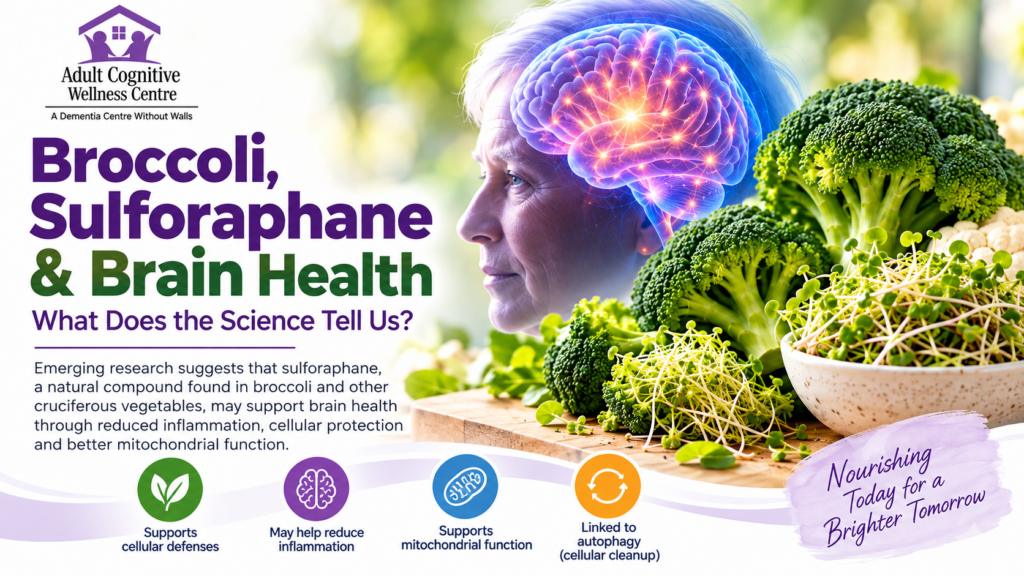
Broccoli, Sulforaphane and Brain Health
What does the science tell us?
An educational article from the Adult Cognitive Wellness Centre
Could something naturally associated with broccoli play a role in supporting the aging brain? Researchers are increasingly interested in sulforaphane, a bioactive compound produced from glucoraphanin found in cruciferous vegetables such as broccoli and broccoli sprouts. The science is intriguing, but it is important to distinguish promising biological research from treatments that have actually been proven in people with dementia.
What is sulforaphane?
Sulforaphane is an isothiocyanate formed when glucoraphanin and the enzyme myrosinase interact, such as when cruciferous vegetables are chopped or chewed. Scientists are particularly interested in sulforaphane because it can activate Nrf2, a transcription factor involved in the body’s cellular defense response to oxidative and other forms of stress.
Why are researchers interested in the brain?
Aging and neurodegenerative disease involve many interacting biological processes. Research has examined oxidative stress, neuroinflammation, mitochondrial function, protein handling and cellular cleanup mechanisms such as autophagy. Laboratory and animal studies suggest sulforaphane can influence several of these pathways, including Nrf2 signaling and autophagy. However, much of the Alzheimer-specific evidence remains preclinical, meaning it comes from cells or animal models rather than clinical trials demonstrating treatment of Alzheimer’s disease in people.
Important: Sulforaphane has not been established as a treatment or cure for Alzheimer’s disease, dementia or mild cognitive impairment. Findings from laboratory models should not be presented as proof of clinical benefit.
What has been studied in older adults?
A 2022 double-blind randomized controlled trial included 144 healthy older adults who received a sulforaphane intervention or placebo for 12 weeks. The sulforaphane group showed improvement in processing speed and a reduction in negative mood compared with placebo. The study did not find significant effects across the other measured biomarkers of oxidative stress, inflammation or neural plasticity. This is an interesting human finding, but it does not demonstrate that sulforaphane prevents or treats dementia.
What about Alzheimer’s disease?
Preclinical Alzheimer’s research has reported effects involving antioxidant and anti-inflammatory pathways, amyloid-related processes and cellular protection. Reviews of this literature describe Nrf2 activation as an important proposed mechanism. These findings help scientists identify pathways worth studying, but clinical evidence in people with established Alzheimer’s disease remains insufficient to recommend sulforaphane as a dementia therapy.
The bigger picture: brain health is more than one nutrient
The most useful message for families is not that one vegetable or supplement can prevent dementia. Brain health is influenced by many factors. A broader wellness approach can include nutritious food, regular physical activity, cognitive stimulation, meaningful social connection, music and creative activities, good sleep, and management of cardiovascular and other health risks.
At the Adult Cognitive Wellness Centre, we focus on meaningful engagement and cognitive wellness rather than promising a cure. Nutrition science can be part of brain-health education alongside movement, cognitive stimulation, social participation and purposeful activity.
Food first – not supplement first
Eating broccoli and other cruciferous vegetables as part of a balanced diet is different from taking concentrated sulforaphane or glucoraphanin supplements. Supplement formulations and doses vary, and older adults may have medical conditions or take medications that require individualized advice. Clients and families should speak with their physician, pharmacist or registered dietitian before starting a supplement.
A practical message for clients and families
Broccoli is nutritious. Sulforaphane research is promising. But there is currently no evidence that broccoli or a sulforaphane supplement cures Alzheimer’s disease.
The emerging science gives us another reason to study how nutrition interacts with cellular health and cognitive aging – while continuing to support the many everyday habits that contribute to overall brain wellness.
Scientific references
- Nouchi R, Hu Q, Ushida Y, Suganuma H, Kawashima R. Effects of sulforaphane intake on processing speed and negative moods in healthy older adults: Evidence from a randomized controlled trial. Frontiers in Aging Neuroscience. 2022;14:929628.doi:10.3389/fnagi.2022.929628.
- Kim J, et al. Pre-clinical neuroprotective evidences and plausible mechanisms of sulforaphane in Alzheimer’s disease. Review of experimental evidence involving Nrf2, oxidative stress, inflammation and related pathways.
- Zhang S, et al. Sulforaphane inhibits the production of amyloid-beta partially through activation of Nrf2-regulated oxidative stress. Food & Function. 2021;12:11482-11490. doi:10.1039/D1FO02651H.
- Review literature on sulforaphane and neuroprotection describes proposed effects on Nrf2 signaling, mitochondrial function and autophagy, while emphasizing that much of the evidence in neurodegenerative disease is preclinical.
Medical disclaimer: This article is for educational purposes only and is not medical or nutritional advice. Sulforaphane supplements are not established treatments for Alzheimer’s disease, dementia or mild cognitive impairment. Individuals should
consult an appropriate healthcare professional before taking supplements or making significant dietary changes.